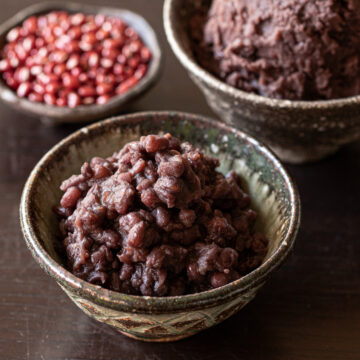
Homemade Anko (Red Bean Paste) — Smooth or Chunky
A simple adzuki bean paste recipe with lightly sweet flavor, made from cooked adzuki beans and sugar. This recipe shows two styles: a smooth, spreadable koshian-style paste and a chunkier tsubu-an with whole beans.Both start the same way, but the texture changes depending on how you cook and handle the beans.You can also use store-bought cooked beans for convenience.
Equipment
- Saucepan
- Spatula
Ingredients
- approx. 650 g cooked adzuki beans unsweetened, from 200g dried
- 100 g beet sugar or raw cane sugar about 15% of the cooked bean weight
- bean cooking liquid or water as needed
Instructions
Before you start
- Check that the adzuki beans are fully cooked. Press one between your fingers — it should mash without resistance. If still firm, add some cooking liquid or water and simmer until tender.approx. 650 g cooked adzuki beans, bean cooking liquid or water
This step really matters: once sugar is added, the beans will not soften further.
Add the sugar
- Add the cooked beans to a saucepan.
- Add a portion of the sugar and stir to combine.100 g beet sugar or raw cane sugar
- Place over high heat until the sugar dissolves, then taste.
- Add more sugar as needed, letting it dissolve each time, and adjust to your preference.
Keep in mind the sweetness mellows as the paste cools — aim for slightly sweeter than you want in the finished result.
Pattern A: Cheat Koshian (for ohagi, mochi, fillings)
- Once the sugar has dissolved, keep the pan on high heat.
- When the mixture begins to bubble, reduce to medium heat and continue stirring, running the spatula along the bottom of the pan.
- When the paste starts to splatter, reduce to low and keep stirring continuously. The beans will mash naturally as you go.
- When the spatula leaves a clear trail through the paste, remove from the heat.
- Once cooled, transfer to a container and refrigerate.
Stop just before it reaches your desired consistency — the paste will firm up as it cools, so it should still feel slightly softer at this stage.
Pattern B: Chunky Tsubu-an (for anmitsu, crepes, toppings)
- Once the sugar has dissolved and the mixture begins to bubble, reduce to low to medium-low heat.
- As the paste reduces, stir occasionally from the bottom of the pan, handling the beans as gently as possible.
- When you begin to hear a light sizzling sound, reduce to very low heat and switch to continuous stirring, keeping the spatula against the bottom of the pan.
- Remove from the heat just before it reaches your desired consistency — the paste will firm up as it cools, so stop while it still feels slightly softer.
- Let the paste cool, then transfer to a container and refrigerate.
At this stage, stir only once or twice from the bottom — just enough to prevent scorching, without breaking up the beans.
Notes
▶︎ Sugar Ratio
Traditional anko often uses 70–100% sugar relative to the weight of dried beans. This recipe uses 100 g of sugar for 200 g of dried beans (about 50%), which gives a lightly sweet result — a level that feels balanced to me, as someone who doesn’t usually eat very sweet foods.If using store-bought cooked beans, use about 15% of the drained weight as a starting point.